Surf Forecasting Explained

Joe Walsh • August 9, 2018

At every break, there’s always that one surfer who knows exactly what the waves, tide, and wind are doing at any given time. He or she is so in tune with the ocean, they seem to have an internal surf forecasting mechanism that’s never wrong.
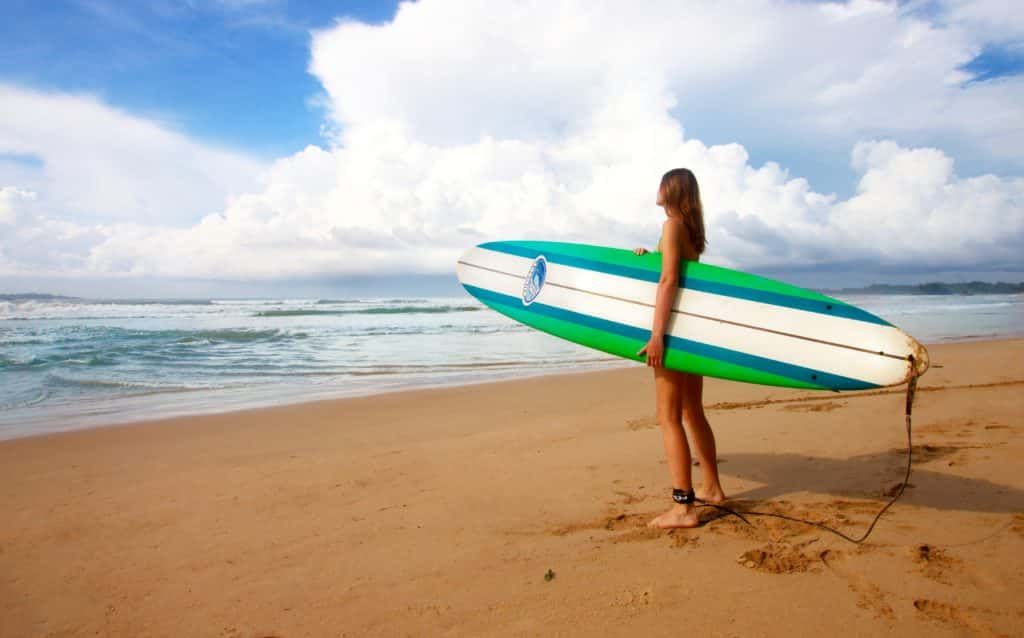
If your knowledge of your local break is at that level, color me impressed, but most of us require some pretty powerful forecasting tools to see if and when we should paddle out. Surf forecasting is the most advanced it has ever been. Swell is predicted nearly a month ahead of time and tracked accurately until they make landfall.

It has never been easier to score waves, but that doesn’t mean interpreting a surf forecast is easy. For a lot of us, surf forecasting might as well be another language. No worries, though, WRSC is here to help with our handy guide to surf forecasting! Dive in and let us walk you through the important components of your daily forecast.

Wave/Surf Height
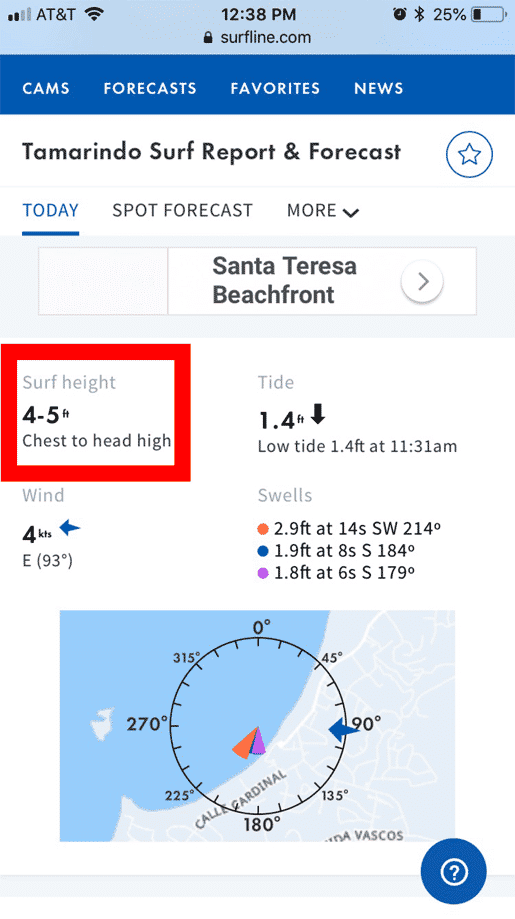
Wave height might seem pretty self-explanatory, and for the most part, it is. But if you look closely, you’ll notice that under the “4-5 ft” forecast, there is text that reads “Chest to head high.” For most people, 4 feet and head high don’t mean the same thing, but for wave height, it just might. Waves are measured from the cresting portion of the wave, not the face. Wind and bottom contour have a significant impact on how tall a wave’s face actually seems. So a wave that measures 4 feet from the back could easily have a 6-foot face.

Wind Direction & Speed
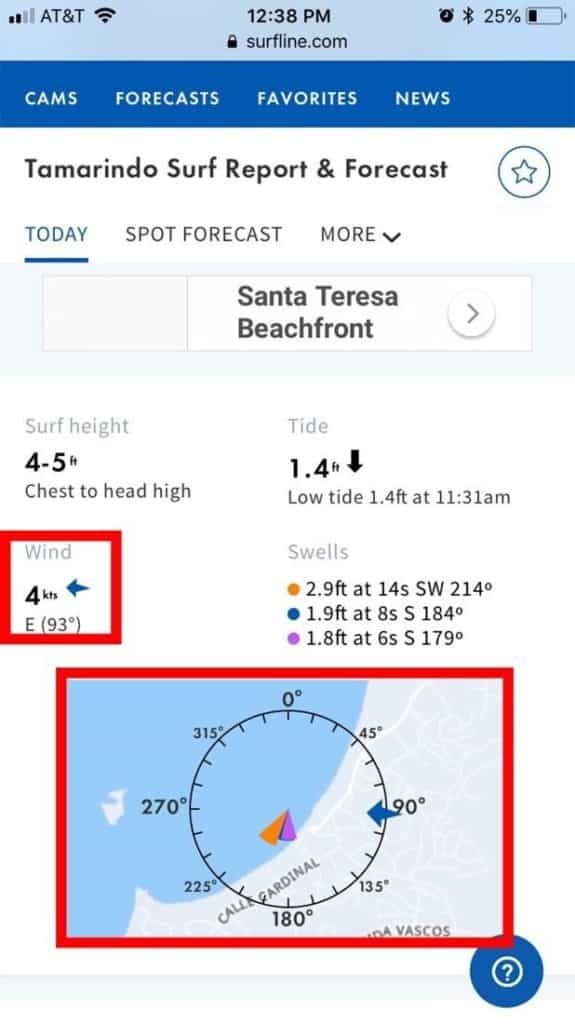
An important factor in wave quality is wind. Wind direction and speed to be specific. 2-3 feet with offshore winds is a great day of fun surf, 2-3 with onshore winds is a choppy mess. Beyond direction, speed plays a part as well. High winds are typically never a good thing. Gentle winds, however, can mitigate the damage of a less than ideal wind direction. Meaning that surfing on an onshore day is significantly less miserable in gentle winds. Above, in the highlighted sections of the image, you’ll see wind speed and direction listed and shown with a blue arrow on the map. The best winds are generally light – moderate offshore which means blowing from the land to sea. This will groom the waves like a fine tooth comb and dramatically increasing your chances of finding barreling waves.

Swell Direction
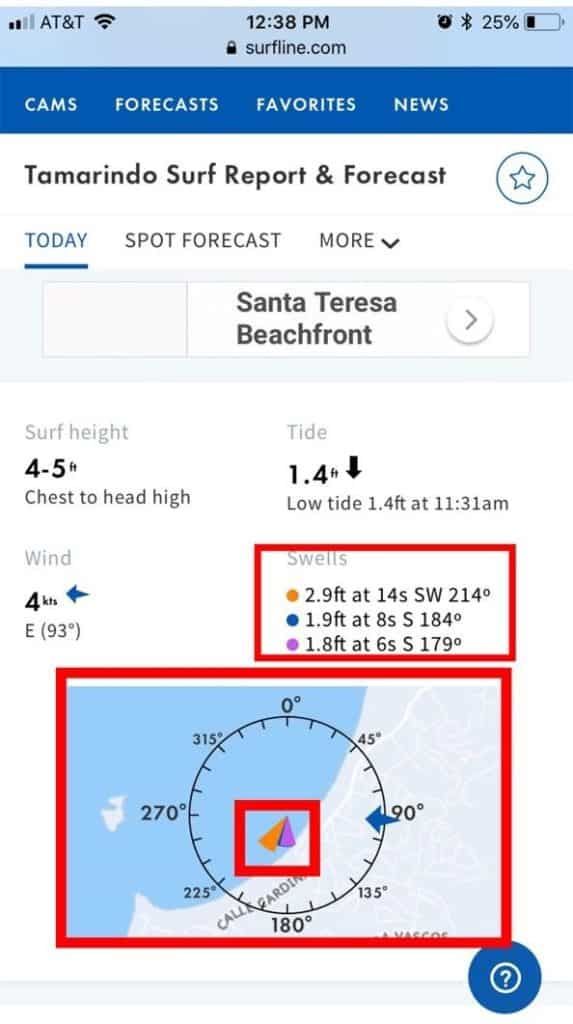
Swell is never a bad thing, but some spots can only handle swell from certain directions. If you’ve got a south facing beach with a reef running parallel to the coast, chances are that spot is going to turn on during south swells. If your break is exposed to nearby deep water, it may work in multiple swell directions. In the image above, you’ll see a primary, secondary, and tertiary swell with their directions marked on the map. Generally speaking, surfers want the swell angle to be somewhat perpendicular to the shoreline for maximum exposure.

Tide
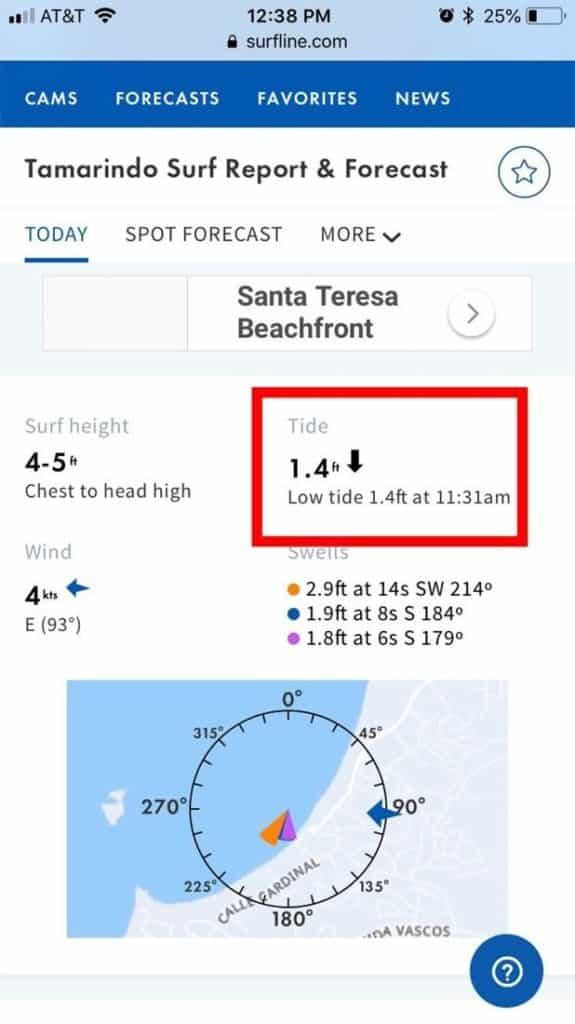
Tide seems simple enough. The tide is either coming in or going out. So how does tide affect your surf break? Certain sand bars and reefs require a lower tide so that it is shallow enough to cause the incoming swell to break. While at other breaks, a low tide might expose dry reef, which could be dangerous. Finding the best tide for your local spot is as easy as looking it up on the Internet, or simply checking the tide after a great session and making a mental note of what the tide is when your wave is working. Generally speaking, incoming tide is the best for wave consistency and less rip currents.

Swell Period
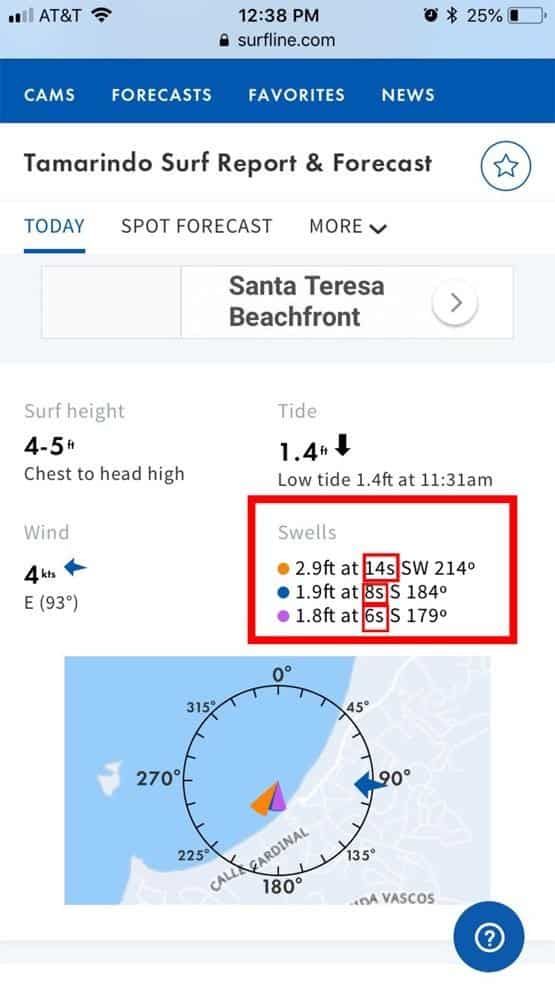
Swell period might be the most overlooked category by novice surf forecasters. Swell period is the measured time between waves recorded in seconds. It’s generally accepted that anything below 6 seconds isn’t surfable. Swells traveling from farther away will typically have a longer swell period, which will result in cleaner, larger, and more powerful surf. Swell period has a direct impact on the height of the wave. 2-3 feet at 7 seconds is exactly that 2-3 feet. 2-3 feet at 16 seconds might actually be 5-6 feet. Understanding swell period is crucial to accurate surf forecasting. The higher the swell period, the more downward energy the wave has allowing it to grow as it approaches shallow water.

Armed with your newfound ability to read forecast, get out there tomorrow – check the waves – and score!

Like this blog? Check out more SURF SCIENCE blogs here.
By Niki Hurren August 5, 2026
Best App for Surfers
By Witch Rocks Surf Camp August 5, 2026
Yes — Tamarindo is considered one of the safest beach towns in Costa Rica for tourists. Most incidents involve petty theft, while violent crime affecting visitors is rare. With basic precautions, it’s a very safe destination for surfers, families, and solo travelers. Costa Rica has long been known as one of the most stable, welcoming countries in Latin America. Yet online discussions, headlines, and occasional embassy alerts often raise the same question for travelers: Is Costa Rica safe — and is Tamarindo safe to visit? This guide separates facts from perception , explains why safety concerns are often misunderstood , and looks specifically at Tamarindo through the lens that actually matters: the real experience of travelers on the ground . At Witch’s Rock Surf Camp, we’ve hosted thousands of travelers, families, and solo surfers in Tamarindo since 2001 — giving us a real, on-the-ground perspective of what safety actually looks like here. Understanding Safety the Right Way: Tourist Reality vs Headlines When people search “Is Costa Rica safe?”, they are often shown national crime statistics without context. This creates confusion. Here’s the key point: 👉 Tourist safety is not measured by national crime averages — it’s measured by what happens in tourist areas. National crime data includes: Drug-trafficking activity Gang-related violence Urban neighborhoods far from tourism Domestic and local disputes unrelated to visitors These factors do not reflect the reality of beach towns, surf destinations, or established tourist communities like Tamarindo. The same logic applies everywhere: Crime in parts of Los Angeles does not define safety in Malibu Crime in New York City does not define safety in the Hamptons Crime in Mexico City does not define safety in Cozumel Tamarindo must be evaluated as a tourist destination — not as a national statistic. Is Tamarindo Safe Compared to Other Popular Destinations? When Tamarindo is compared properly — city to city, destination to destination — the picture becomes clear.
By Witch Rocks Surf Camp August 5, 2026
If you’re searching for the best surf spots on the Pacific side of Costa Rica, then you’re in the right place. Picture this – warm sun, crystal-clear water, and world-class waves calling out to surfers from near and far. Costa Rica consistently ranks as one of the best surf destinations in the world.
surf
By Witch Rocks Surf Camp August 5, 2026
If you are dreaming about a surf trip to Costa Rica you are probably asking yourself one big question. When is the best time to surf. The real answer is that Costa Rica has surf all year.
Witch’s Rock
By Joe Walsh August 5, 2026
Witch’s Rock, the wave from which we derive our namesake, popularized by The Endless Summer II most definitely lives up to the hype. If you’ve seen the movie, you know what this wave can do during a swell. Simply put, it’s a leg burning barrel. Witch’s Rock handles swell very well, it gets big, and it gets hollow. What
By Witch's Rock - Costa Rica Surf Camp May 25, 2026
Most kids can start learning to surf between ages 4 and 7, depending on their comfort in the water, balance, confidence, and excitement about trying something new. At Witch’s Rock Surf Camp in Tamarindo, Costa Rica, we’ve taught surfing to children as young as 5 years old using beginner-friendly waves, personalized instruction, and a safe […] The post At What Age Can Kids Start Surfing? appeared first on Witch's Rock Surf Camp.

By Witch's Rock - Costa Rica Surf Camp March 23, 2026
Trying to choose between Costa Rica and El Salvador for your surf trip? Both offer world-class waves, but the experience is very different depending on your level and travel style. Costa Rica: More versatile, beginner-friendly, and easier to travel El Salvador: High-performance waves, best for experienced surfers When it comes to surf, scenery, and adventure, […]
By Witch's Rock - Costa Rica Surf Camp March 19, 2026
Planning your first trip to Costa Rica? You’re in for an unforgettable experience filled with warm water, incredible waves, and a laid-back lifestyle known as “Pura Vida.” To help you make the most of your trip, here are essential travel tips every first-time visitor should know. 1. Understand the “Pura Vida” Lifestyle Costa Rica moves […]
By Witch's Rock - Costa Rica Surf Camp March 19, 2026
If you’ve ever traveled to Costa Rica — or even researched it — you’ve probably heard the phrase “Pura Vida.” But what does it actually mean? More than just a saying, “Pura Vida” is the heartbeat of Costa Rican culture. It reflects a way of life centered around positivity, simplicity, and appreciation. The Literal Meaning […]